Showing posts with label st. Show all posts

November 28 29 St Marys to Cumberland Island and Lay Day There 6 5 Miles

Another short passage, though made longer because Lene had to go grocery shopping again, her fourth day in a row! So we did not leave until early afternoon, when the tide was flooding into the St. Marys River, reducing our speed. Once we arrived and the anchor was securely set, some course plotting for the stops between here and Fort Lauderdale, a good dinner and we snuggled in for a night that was supposed to be even colder than the one before, but wasnt. While I played with the charts, Lene checked out Cumberland Island by trhe internet. It is a "National Seashore" administered by the National Parks Service. Im grateful to Dick and Elle for suggesting Cumberland as a great place to stop and to Lene who found the activities on the island. It is very roughly the size of Manhattan Island and we passed its beachy Atlantic coastal side while heading south for the St. Marys River inlet about a week ago. Our anchoring location was on its east coast, just off "Sea Camp", the NPS ferry dock,
Dinghy left, ILENE, right


where small boatloads of passengers come over from St. Marys, twice a day, to mingle with folks like us who come on our own bottoms.
All the tourists are also divided among those, like us, who spend a day (or less) on the island and those who bring tents, food, water etc., and camp out at its camp sites, by permit, for up to a week, $4.00 per head! The campers can be further divided between those who take campsites less than a mile from the dock, and those who carry all their stuff up to eleven miles (and back) to camp at wilderness sites.The eight folks here came as a group, took the near option and very friendly.
We were fortunate to get two open spots (another couple had not been able to make it) on a guided tour for eight people in a government van for only $12 per senior.


led by NPS agent Roy

This was a six hour tour and Roy kept talking to us throughout and answering our questions about the geology, flora, fauna, history and politics of the island and the state of Georgia.  He was a great tour guide and very knowledgeable...and isnt allowed to accept gratuities!


We saw an armadillo


and more than a dozen of the 150 wild horses who inhabit this island.
They receive no food or veterinary services but live breed and die on the island and are quite unafraid of humans. They are smaller than the jumpers and hunters I know from barns and their life expectancy is half that of domesticated horses. They and the wild boar, were introduced here by the Spanish. We also saw wild turkeys and deer, close up, but without photos.
Live oaks predominate. This one  extends further to the right than shown, and as you can see, is quite wider than it is tall. They
are not harmed by the Spanish Moss that hangs from them, except to the extent that when wet, and the moss can hold up to ren times its weight in water, can break branches off the trees.. The branches can curve down to the ground and back up again, when they grow in open cleared fields, like the one pictured. Most of them are "Second Growth"; the primeval forest having been cut down to supply curved timbers for building ships like Old Ironsides, the USS Constitution, made largely of Cumberland Island live oak.
We visited the first African Baptist Church, near the north end, a very small, one room chapel in which John John F. Kennedy Jr. was married. It was also visited by President Carter, a Georgia boy.

We stopped at Plum Orchard, a huge formal house, of about 25,000 square feet, built by the widow of Andrew Carnegies brother, for one of their sons and his wife. Completed with indoor squash court and swimming pool about 112 years ago, it reminded me a bit of Downton Abbey, in terms of the social structure and activity norms of the people who lived there.


Even larger, 37,000 square feet, was the Dungeness Mansion, built by Mrs. Carnegie for herself on the ruins of the home of the former plantation owner. Her kids decided not to maintain it after her death so only the stone and bare verticals remain.
Ms. Carnegie owned about 95 percent of the island. Sadly, those kids, who never had to go to school or do any work, generally died young, of alcohol related disorders. Roy told us there were very limited fond feelings among the children for their mother.

The island is now almost entirely owned by the government but about five percent of it is held by about 25 folks with "reservations of rights", i.e., the right to exclusive control of their land until they die. Then, one by one, the government will take over and will either restore the buildings for park or administrative uses if they have historic value or raze the structures and let the wilderness take over again. One such rights holder is Carol, who like the horses, lives off the land, at the north end, and has done so for 44 years, while becoming an expert on sea turtles.
This wall is made of "tabby" which is home made "cinder blocks" molded from burned seashells, sand and water to make a cement in which unburned sea shells are embedded in lieu of gravel to make concrete.


In the morning I went back for a walk across the island to the sea. Even with light waves, you could hear the Atlantics roar from half mile away. Long board walks to avoid disturbing the very wide dunes;
except the horses tracks show that they ignore the signs.


And then there is a very wide beach. You can barely see the three NC elementary school teachers, seated, half way back to the dunes, just slightly to the right of center.

On our way back north, we hope to explore this island by bike. We loved Cumberland.

Read More..

December 4 9 Jacksonville to St Augustine and Five Lay Days There 46 8 Miles

Bridges made this passage a long one. JVilles Main Street Bridge had requested advance notice so I called the afternoon before our departure and requested a 7:30 am opening and was told OK. I told other boats who were planning to leave that day and all of us prepared to be underway, near the bridge, before 7:30. But one of the other boats called again in the morning to confirm and was told that they were not allowed to open between 7 and 8:30. If the tender had told me this the day before we would all have left at 7, but we had to hang on the dock for another hour plus.
We did not make it out until 8:30 and hence got a somewhat late start considering the distance. ILENE soon led the way and hoisted the small jib to supplement the engine.  But the tide was again only slightly favorable at the start, growing in speed until the right turn, south, into the ICW. There, of course, the same tide was then against us, for several hours.

The only rough spot in the ICW was at the Salamander Landing Bridge, which was high enough but narrow which channelled the tidal waters to run through it fast against us. Bridges, even modern ones on concrete pillars, tend to block the wind somewhat, thereby reducing the efficiency of the sail. But the biggest cause of the sudden drop of speed from 4.8 to 1 knot in a tight swirly spot was the force of the water rushing past us -- like at Hells Gate. Lene had the helm. She cranked the engine a bit higher than we like to run her, for about two minutes, and the danger was past. Then, it became a race for the Bridge of Lions, that crosses the ICW a few hundred yards north of the St Augustine Municipal Marina, which provides moorings.

I got a wonderful pleasant surprize from my beloved Lene today. She has often criticised me for tweaking the sail trim too often. She had the helm and gave me several suggestions to ease or harden the sheet in response to minor changes of course mandated by curves in the ICW and of wind speeds. And her suggestions were correct. The last vestiges of her claim: "Im not really a sailor!" are now toast!! Lene IS a sailor!

But more than five miles before the Bridge of Lions we figured out that we could not go fast enough to make it to its 4:30 opening, and would have to wait until 5:30. So we slowed down the engine, later took in the sail and eventually turned off the engine to simply float with the tide. But we still got there 35 minutes early and had to motor slowly, away from the bridge to try to maintain an approximately geostationary position against the tidal flow. And we got to our mooring after sunset but before dark. Technically this is called between civil twilight and nautical twilight. Underway from 8:15 to 5:45; a long day.

It is the holiday season in St. Augustine with its Christmas parade, including all sorts of clubs and businesses and every school with either a band or a high powered blast of recorded Christmas music. And the central plaza is lighted extensively. One evening saw the end of the annual "Night Watch". Groups of costumed British, Hessian, Native American and Colonist "reenactors" spent the night partying and then marched to the square to hear a reading of the "Proclamation of Freedom" from the Spanish.


We actually skipped the festivities. Its funny though, there are many Hispanic restaurants in town and most of the downtown streets have names such as Castillo, San Marco, Menendez, Ponce de Leon, Sevilla, Carrera, Valencia, Cordova, Ribiera and Aviles. Though I have been told that they regained these Hispanic names from the Anglican ones in the 1920s to promote tourism.
We have had some good weather hours here, but two of the days were very foggy (as had been one in JVille). Fog is less frequent here than in New England but just as unpleasant. And we also had two days of windstorm, making us happy that we were on a mooring rather than anchor. They are called "northers," and mark the passing of a cold front. This one gave us about 48 hours of 25-30 knot winds from the north. The first day we decided to forego the dink, which would have meant a wet ride, and take the marinas launch in to town, even though its hours are inconvenient -- only at 10, 12, 2, 4, and 6.  But the second day of the wind storm, our plan to leave that day having been adjourned, the launch came out to yell that it was too dangerous for them to take is in. So we had a day aboard for reading, blogging, correspondence and I plotted out the routes and distances of each remaining leg from here to the Dry Tortugas. It was a roly day because the strong north or south flowing tidal currents determine which way the goat faces, but the stong northerly winds, when in opposition to the currect turn the boat so it is not facing the wind, causing it to be rocked by the waves coming at the side.

 Notice boats facing different ways, the one on the right is "pinned" with its mooring ball rubbing at its side rather than out in front

We had breakfast at a Athena, a greek restaurant one day, lunch at O.C. White, an American fish place, another and pizza for dinner on our last night. The lunch was with Dean and Susan of "Autumn Borne" and their friends, Cathy and Earl, from North Carolina, of  s/v "Seeker". The Autumn Borners shared a bottle of wine with me another night,
For all the many folks who have had blueberry and or mango pancakes on ILENE, you have to come back. Why? To try the new and definitely improved sweet potato ones we tried.
Ilene spent quite a bit of time in the laundry room lounge, not just doing laundry, but also watching her TV programs on the excellent wifi -- excellent except that it does not reach the boat, half a mile away. I visited a store that sells used and some new boating stuff. I was looking for a teak pencil holder to attach to the nav station so I wont have to open its desk top to get a pencil. While they had a lot of stuff including lots of teak fixtures, this item was not among them. I did get a set of running lights for the dink to replace the ones that had gone bad. I wish there was such a store in the NY area. Another day I paid $5 for a round trip in a van to a supermarket to get everything on Lenes list.
I also polished and waxed more of the exterior stainless. And with Deans help we overcame a problem with coffee one morning: No propane was flowing to the stove. I checked the fuse, that the tank was full and got out the documentation we have on the Trident propane control and detector system. Dean brought a thermos of hot coffee with him and we continued to try to localize the problem. He took apart the solenoid. The electricity either turns it on to allow the flow of propane from its outside locker to the stove or cuts off that flow when a connected sensor detects a leak in the cabin. Finally we discovered the problem: a butt connector (it joins two wires, end to end, to allow electricity to flow from one through the other) under the galley sink had come loose. A wire was just dangling there. So crimping on a new connector solved the problem. Thanks again Dean, and for the coffee too!
During Lenes marathon sessions with Breaking Bad, I did some sightseeing. Not the fort and the two big former luxury hotels now a museum and a college. We had toured them in 2012. Instead, one afternoon I visited about ten of the many galleries. My favorite was Bouvier Maps and Prints on Avila St., (the oldest street in the US). Im juist a sucker for poring over maps, including expensive antique maps. Mr. Bouvier did not have charts published by the US Navy Hydrographic Office but many others of ports we have sailed in.
I also took the tour of the Hispanic Military Hospital Museum.
The young lady explained that Spanish society had developed much higher standards of certification of medical service providers and, more importantly, sanitation, compared to the British. She attributed this to the influence of the moors in Spain for hundreds of years, for whom hand washing, for example, is a religious obligation. I further attributed it to the influence of Jewish physicians such as Rabbi Moses Mainonides, the personal physician of the moorish ruler, on the moors. I also toured an exhibit in the town hall that, like all the others celebrated Floridas cultural diversity.


Another day I visited the Barracks, now the headquarters of the Florida National Guard with this brilliantly polished brass cannon out front,
the Royal Bakery (disappointingly now simply an auto garage), and the Gonzalez-Alvarez House, reputed to be the oldest, with its coquina (shell limestone) Hispanic first story and a wooden British second story having been added. The docent revealed that in the Victorian period the new owner had added Victorian additions that the Historical Society had removed after it took over the house in 1918. More cultural exhibits, followed by a room of maps of the world and later Florida, from the 16th through the 21st centuries. And there are more historic sites to visit on future stops in St. Augustine.

Actually we had planned only three lay days here and ended with five. The first of the extra days was while the wind howled. The second was also related to the wind. It had kicked up a sort of "storm surge" which raised the water level in the ICW. When we approached the first fixed 65 foot high bridge, about two miles south of the mooring at about 8 am, we took a look at the white board with numbers showing the feet above the water level that the bridge is. The water washed it at 62 feet that morning and our mast is 63.5 feet above the water. So I slammed us into reverse and gave a lot of throttle to overcome our seven knot forward speed and get away from the bridge. And the water was scheduled to rise until 10 am and not get low enough until the afternoon, too late to start a passage of more than 40 miles. So we went back onto our mooring to wait until the next day.
Read More..

November 24 27 Fernandina Beach FL to St Marys GA 6 8 N Miles

Yes, there should be an apostrophe in "Marys," on the north bank of the St. Marys River, but there is not. And yes, we have gone north, about three of the 6.8 miles, from Florida into Georgia.
We spent four nights at the end of the west dock of Langs Marina. Many of the boats elected to anchor out in the wide, roomy anchorage, though it is beset by tricky tidal currents and strong winds.
The marina is funky to say the least. Most businesses strive to modernize and offer the best and latest conveniences. But not Langs. The cruisers guides warned us to wear slippers in the shower rooms; they are not cleaned very regularly and are old fashioned. The electric towers into which we plug our thick yellow shore power cables offer electricity at only $3 per night -- if you can get it. Most of the towers, including those near us, do nor work and apparently have not worked for several years. This was inconvenient because it has been cold here and Lene would have liked heat. Help with our lines getting onto the dock? Sure; if your neighbors are about and willing to help.  There are some pretty nice boats here, power and sail, including, across the dock from us, a DeFever trawler operated by the founders and owners of the Active Captain website. But Langs is also home to some boats that look rather derelict. And as you can see in this picture of two felines concentrating intently of the bravest of the remaining birds, guano is not washed form the dock except by the rain.


There are some more beautiful birds here too.


We are about 1000 feet from the street. Another thousand feet brings you to Seagles hotel, saloon and restaurant, where the festivities are held.


Thirty rooms upstairs at $90 to $130 per night.
 Langs is priced appropriately, only $1 per foot per night.
We arrived on Monday and each evening there was more and more shared food with drink getting our stomachs enlarged enough for the major feast at 1 pm on Thursday. There is also a communal check in on VHF radio channel 69 each morning, chaired by Ann of s/v "Sea Tramp". Her husband, Lynn, runs daily or twice a day trips with his van to where ever you may need to go in the area, including the supermarket (Lene went three times!), laundry, pharmacy, dry cleaners, propane refill, eye glass repair shop, etc.
We have been hearing about "Thanksgiving at St. Marys" for years and decided to join in this time. And we are glad we did. Dean and Susan of "Autumn Borne" are known by everyone here, probably because Dean has helped most of them, but they especially befriended us and introduced us to a lot of folks who we will be meeting up with further south in the months and years ahead.
Lene flanked by Dean and Susan and, at the sides, by the crew of s/v "Summerwind". Lets face it: the others here are mostly all retiree snow birds, like us, who come from all over the US, though some of us live aboard year round and others revert to land bases when not cruising. Good folks with a common interest in our boats and in telling each other and listening to each others sea stories. For the feast, the townspeople provided the baked turkey and ham and the cruisers each provided a side dish, salad, stuffing, desert, etc., sufficient to serve ten. But most brought more and this was no hunger game.


For the record, I made blanched string beans with bacon, blue cheese and toasted walnuts, and it got eaten up by the throng.


With the town abutting the back side of the Kings Bay submarine base, the town is postered by these bumper stickers:
Every Day In Camden County Is Military Appreciation Day.


They have a Submarine museum
a block from Seagles, where I spent a few pleasant hours. There I met Mr. Treen, a naval electrician with 18 years of service in the submarine service, currently assigned as base photographer. He was doing a story on the museum.
I got to remembering my six day ride on one of our submarines, the USS Requin (SS-481) As Hammerbergs Anti Submarine Warfare officer, I was exchanged for the Requins weapons officer for the segment of our circumnavigation of South America from Montevideo to Rio in 1966. My biggest thrill: they let me dive the sub. I yelled "Dive!", scrambled down the conning tower as quickly as possible so that others could slam closed and dog down the hatch above my head before water started to flow in and then yelled the command: "Blow negative to the mark!"  This meant to release compressed air into a forward compartment sufficient to give buoyancy to the bow and thus level off the dive. And then the submariners, who knew what they were doing, took over again. I recall the palpable sensation of quiet after we were submerged; the crashing sound of the water while a surface boat slices through it was replaced by utter silence.

Tomorrow, a communal pancake breakfast (yes more food!!), a swap meet and then we plan to go east and a bit north to an anchorage off Cumberland Island National Park for a few days before resuming southward from the St. Marys area.
Read More..

May 23 24 St Michaels to Chesapeake City to Cape May 68 9 and 68 Miles

The first day of this holiday weekend John and I got underway at 7:15 after I water taxied Lene and the felines in their carrier to Johns car and we raised and secured the dink. And we docked at 8 pm. But we were not actually underway the whole time. We detoured into Annapolis after passing about eighty boat flying spinnakers, racing the other way, headed from Annapolis to St. Michaels. We stopped in Back Bay to fill the fuel tanks, which took an estimated 90 minutes of in and out and waiting on line for the fuel dock with only about 15 of those minutes for the actual fueling.
Our second stop of the day was when we run into the mud trying to enter the harbor on the south side of the C and D Canal, where I had stayed in 2006 on ILENE and last fall on sister ship Pandora. We backed right off the mud and tried to call the marina by phone and VHF. Finally, the person said, "I dont know if you can make it in now, near low tide, but hug the seawall on the left side of the entrance." This was not very reassuring. We had noticed a long high fixed dock with two or three small power boats tied up to it and a busy restaurant on the other side of the canal, less than a quarter of a mile back- Scheafers. Not seeing any sailboats there, I called to ask about depth and they said they had 20 feet minimum at the dock, which our depth meter later confirmed. But they "had to charge us their holiday rate", $2.50 per foot. The restaurant and bar were large and jammed with revelers. We had dinner there and the food was OK.  It seems the place burned down about ten years ago and has recently reopened. It is so easy to get in and out that this will be a place Ill return to, even though they do not have water, electricity or wifi.
Why did it take so long, you might ask. Well the tides were against us all day. We went down the Miles River from St. Michaels against the flood which turned to ebb when we rounded Bloody Point to go north up the Bay. Six hours later this should have changed but then we were confronted by water flowing toward us from the Delaware. Well we have had all-day good tides too, but not today.
John was great help all day, a knowledgeable cautious seaman.
His 28 S2 sloop, "Hearts Content" passed its survey the day before with flying colors. "The best maintained 35 year old S2 I have ever surveyed" said the surveyor. She was Johns friend for the last 25 years, but he also has a 22 foot power boat, "Dixie," and he was not using the sloop and has found her a good home. Second happiest bittersweet day in a mans life: when he sells his boat.
Next morning we continued in the canal starting at 7:15 and found favorable tide. Belt and suspenders, do you think:
No, just an optical illusion with the arch further away and the pretty suspension bridge that Lene drove over the day before in the foreground.
Once in Delaware Bay, the tide was an even bigger help and we made over nine knots until noon. Delaware Bay is a wide boring passage except when freighters pass you by. See bow wake.
As the day wore on, the wind came up strongly, with about 35 knots and gusts to 45 showing on our meter, (though I sense that it reads about five knots too fast). So we had only the small jib and were beating down the Bay. The tricky part was rounding Cape May. The outer passage is a long way around some shoals, which would have added about the miles to our trip in rough weather toward the end of the day. The inner passage saves those miles but put ILENEs port side only about .2 miles from the beach with those big winds and the big waves they created trying to push her onto the beach. We had furled the small jib to gain control over safety for this part of the passage. John wanted the more cautious longer passage, as had part of my crew in 2006 when we did this in calmer weather. We have pictures of the beach with its lighthouse taken from this in close route on this blog in June 2012, on a rather calm day and had done the trip in the opposite direction last fall. Today we were too busy for pictures. it was a two person operation. John steered or to be more precise, controlled the autopilot and watched the waves. One of them sent a spray of water up over the boat soaking him completely. My job wasq operate the InavX on Lenes Ipad, while crouched in the companionway, to protect it from the spray and shade it from the sun. I directed, for example: "Turn right ten degrees." It was like instrument flight rules or sailing in thick fog. I directed our course from the electronic chart, around shoals charted as little as nine feet deep, keeping us in water at least 13 feet deep, without looking up to see where we actually were or where we were going. It was scary but we made it.
Once around the Cape, we turned more north toward the two stone seawalls that mark and protect the channel entrance into Cape May Harbor from the Atlantic. It seemed that we would be surfing down waves barreling directly into the harbor so I turned toward the beach for a practice run in that direction and ILENE seemed to handle it well. In the reality, however, the waves were at about a twenty degree angle from the channel and our passage between the seawalls was relatively easy. We anchored near the Coast Guard Station in about ten feet of water off the green side of the channel with sixty feet of snubbed chain. We were one of about six boats there, each far enough from the others and protected from the SW winds by the land mass of the Cape. John was a bit nauseous, though more from nerves than motion sickness, I think.
We were in by 5:30 and after a breather it was time for dinner. I have tried to get John to try foods that, while within his vegetarian practice, were different from his routine. Tonight we shared his food. I sauteed and steamed some veggies, fake chicken strips and onions, mixed them with whole wheat pasta and dressed it with soy sauce and grated cheese. Pretty good, and it better be because the leftovers is tomorrows dinner too.

Read More..

May 19 22 Solomons to St Michaels and Three Lay Day There 50 7 Miles

Underway 9:30 to 5:45.  Winds "light and variable" said NOAA. And they were directly from the north until noon when we put up the rags as our course came to 020 and we were on a starboard close hauled reach which broadened. We passed some interesting sights. Cove Point Light disproved my prior assertion that there are no pretty lights in the Chesapeake.
Night passages require you to keep in the center to avoid unlighted fish weirs like this one, quite a ways off shore.
  This is part of a dock for the off loading of liquid natural gas into tanks ashore.
A voice on VHF told a boat passing closer than a quarter mile to keep off - security zone.
For about an hour we sailed without the engine, at about four knots; light and variable. Back to engine when our speed got down to two knots. Lene heard something funny and reported that no water was coming out of the salt water cooling exhaust, so we quickly turned the engine off and continued slowly under sail. I checked the intake of seawater into the boat and it was not clogged. So we tried again and either we had not had a problem in the first place or it went away spontaneously. Warm seawater spurted out of the exhaust, again.
Our friends, Mike and Janet, ex Harlemites whose lovely home we visited in Ft. Pierce, FL, have their summer home here. Janet scouted out the anchorages, which get crowded on beautiful summer weekends. In 2006 we came here twice and docked once at the marina and once in the Maritime Museum. But it was Tuesday and before Memorial Day, and there were no other boats on anchor so we came into the small inner harbor, in eleven feet of water on 65 feet of snubbed chain. This was preferable to the large but exposed anchorage out in the river where it is about 18 feet deep. Our private cove.


Lene looks happy after the passage, her last of this winter, and her smile makes her look great, but then again she always looks great.
During the night the wind came up and either we dragged a bit or our rode got stretched out straight in a different direction. Either way, we appeared closer to the land behind us so we picked up and reanchored.
We dinked in to the public dock and bought groceries at Acme. I got both a postcard and an outfit for my granddaughter when we toured some of the local shops. Returning to land after lunch, we were picked up by Mike, driven around town and to their great home where we hung and talked about old times.
Later we enjoyed dinner with them at the Miles River YC. Yum. A very nice club with an active racing program including Star class boats that are stored ashore and winched down into the water for races. They also race dugouts which are very old fashioned wooden boats with three sails. Their interesting quality is that in lieu of a keel, they use people, as many as four per board, as many as four boards, tucked under the lee gunnel and extending about ten feet out the other side. There crew members are human ballast, leveraged to keep the boats upright. In the Chesapeake Bay Maritime Museum they show a video of these races. Wild! The same sort of idea are raced in Geogetown in the Exumas, Bahamas.
It was the next day, after we had sweet potato mango pancakes at Mike and Janets house, that I visited the museum, seen here from the dink tied to ILENE, with its screwpile lighthouse.
First thing a saw was this T-shirt, which I did not buy.
It further gives the lie to my prior assertion that none of the Chesapeake lighthouses are pretty. It was raining all day.

Another boat came in while Lene was aboard and I was in the museum, and anchored near us. Pretty close but not two close, seen here at sunrise the next day. During our last night, three others crowded in as well.
I spent some time talking with the volunteers who build and repair wooden small craft in the museums boathouse. I learned how they make round masts and spars: they start with a square log and plane off its four corners resulting in an octagonal one. Next step makes it a sixteen sided and then 32 sided, which appears round, but it is sanded with paper stretched across a frame so it has a rounded surface. Neat tricks.
The center of the museum is an exhibit on the myriad ways that folks have used the water of the Bay: as a livelihood, for pleasure as housing and the myriad variations of boat racing, yacht clubs, camps, fishing, etc.

 One three-tree "canoe" exhibited in the boat shed was placarded as having a beam of 62. No way was it that wide; I told the museum people.
Mike and Janet lent us their car on our last day and we drove for sightseeing in nearby Easton and visited its art museum. There we met John and did some provisioning.  John drove back with us in his car in preparation for his voyages for the rest of this cruise, from here back to NYC. This gave Lene the opportunity to drive his car to NY and park it at the Club so John and I will be able to offload perishables and necessaries back to our apartment and he will have wheels to get home to Cambridge MD. This also means that Lene avoided the NYC - Chesapeake passages on both ends of this cruise.
We had planned only one lay day in St. Michaels, two in the Wye River, which we loved in 2006, and two in Annapolis, before the start of the passages home. An all day rain killed off the Wye River and Johns schedule made it better for all us to leave from St. Michaels for home. It seems that plan B usually wins out over plan A.

Read More..

December 10 St Augustine to Daytona Beach 45 Miles

The storm surge having receded from the day before, we got underway at 6:30a.m. motoring the inside passage starting shortly after low tide. We held our breath a few times passing under 65 foot bridges as the tide rose during the day. There were about ten bridges in all but the low ones all opened on request, causing no delays. It began cold but clear and the winds were light. Bundled up, we were warm enough. The ICW here was mostly southerly and deep and wide enough to not be a cause of worry. With the winds mostly easterly, we were able to fly the small jib and later I was emboldened to fly the genoa, which gave us half a knot.

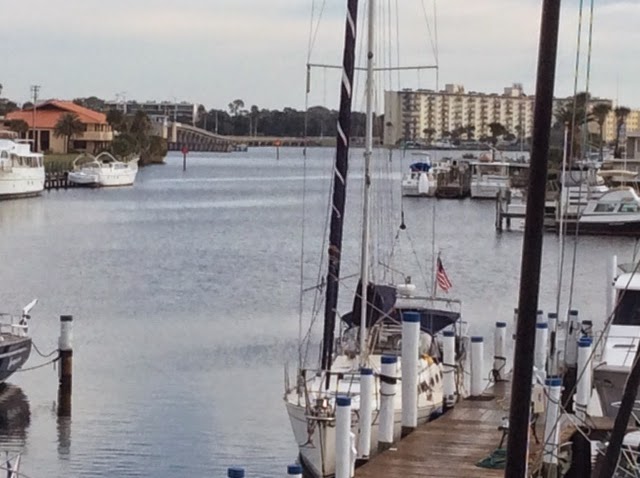
We arrived at the Halifax River Yacht Club  at two. What a club it is. View with Lene from ILENE.


It is easily approached directly from the ICW through a straight, well- marked channel -- a 90 degree right turn west from the ICW just after passing a particular low bridge. You can see the day markers to the sides of ILENEs forestays and part of the bridge to the left.
 The Club is a mile from the beach, using that bridge to cross the ICW.
First built on this site in 1898, it was recently rebuilt. The dockmaster, Peter, formerly a teacher, after directing us to our dock and helping us with our lines and electric cord and brewing a pot of coffee for us, gave us a thorough tour of the place, of which he is justly proud. Im a big booster of the Harlem and could have done no better by the HYC than Peter did for the HRYC. He stubbornly refused our proffered tip. The tides are normally less than a foot here so the docks are fixed, not floating. HRYC has a large and elegant clubhouse and a large membership.  Some of the boats here have been extensively done up in Christmas lights.
The restaurant had only its Tiki menu due to a membership meeting our night there so Peter pointed out several restaurants in easy walking distance, of which we chose McKs Irish Pub. He also pointed out the Clubs health club. He offered to take us to stores in his car and a free bag of ice cubes. The showers are clean and offer a copious flow of hot water. This club has many more members than it has room for boats in its marina. It has three hotel quality meeting rooms and had three outside organizations booked for meetings the day we were there. It has three full time office staff. It offers a free nights dockage for members of any other YC that is part of a council of 30 clubs in Florida. As members of the Harlem we paid only $1.25 per foot. It has an active ocean racing program and a youth program.
The only drawback in my view is that in order to actually sail one has to go fourteen miles south in the narrow ICW and then through the somewhat tricky Ponce de Leon Inlet near New Smyrna to the sea with freedom to select the course you wish. Figuring at least five hours for going out and coming back in, this leaves few hours for a day of sailing.
In the morning we declined the free coffee but Peter took me to the sea for a walk there and I walked back and then took Lene to the Supermarket, waited for her and brought her back.
The beach is quite long and clean. Paddle boarders and surfers were out in wetsuits and the paddleboarders surfed the big waves. I noticed the communities of various species of sea birds standing on the beach, common gulls, those with long orange beaks, with the same beaks but black tipped and sandpipers, all in what appeared to be harmony. I talked with the fishermen on the pier built out into the sea. On my way back, taking the closest street paralleling the beach, I saw the usual suspects: tattoo parlors, salt water taffy, piercing shops, head shops, pizza parlors, fried fish joints surfing shops and those selling towels and tee shirts for women with sexually suggestive double entendres blazoned on the front.
On my way back, from the low bridge next to the Club I shot a view to the north of two high bridges with a low one in between them, under which we had passed.
Read More..